
letter of intent business acquisition
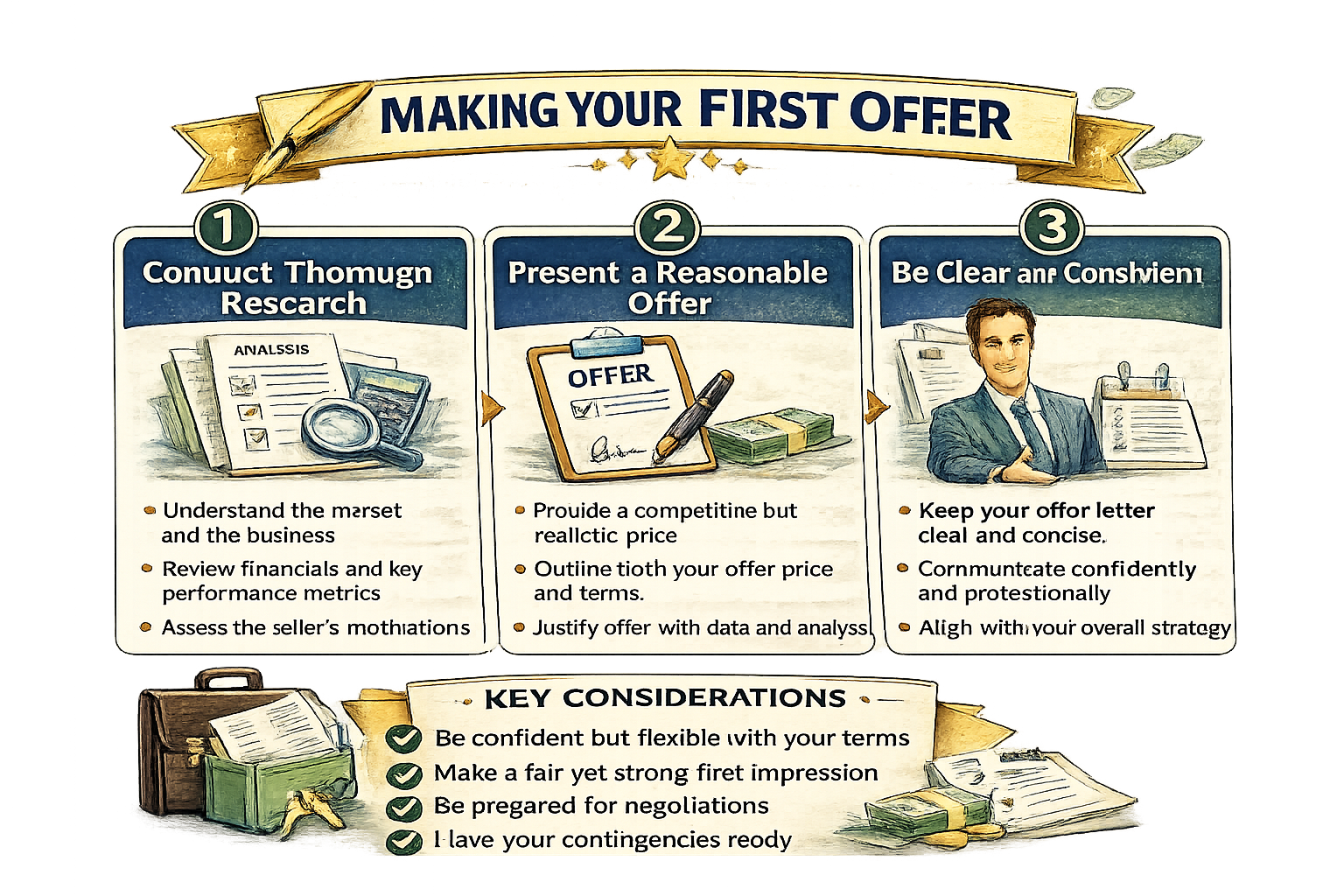
Making Your First Serious Offer
At some point in every acquisition, you stop talking and put something in writing. For most buyers, that first written step is a Letter of Intent an LOI. It signals you’re serious, frames the deal, and opens the door to due diligence.
This guide explains what an LOI is, what belongs in it, how it differs from a full Offer to Purchase, and most importantly how to make an offer that keeps every protection on your side. It’s part of our larger framework on how to buy a business and connects directly to due diligence and how to finance a business purchase.
What Is a Letter of Intent?
A Letter of Intent is a written document that outlines the proposed terms of a deal before the binding purchase agreement is drafted. It says, in effect: here’s the business I want to buy, here’s roughly what I’ll pay, here’s the structure, and here are the conditions that have to be met before we close.

Most of an LOI is non binding it’s a framework, not the final contract. Typically only a few provisions are binding, such as confidentiality and sometimes an exclusivity period during which the seller agrees not to shop the business to other buyers while you do your work.
The LOI’s real purpose is to align both sides on the major terms before everyone spends time and money on due diligence and legal drafting. It turns a verbal understanding into a shared, written starting point.
What an LOI Should Include
A well-built LOI covers the major deal points clearly without trying to be the final contract. At minimum, it should address:
The parties
who is buying and who is selling
The business
exactly what's being acquired (the entity, or specific assets)
Asset sale vs. stock sale
the structure of the transaction, which has major tax and liability implications
Purchase price
the proposed price and how it was reached
Deal structure
how the price is paid: cash at closing, bank financing, any seller financing or earnout
What's included
equipment, inventory, intellectual property, customer lists, and working capital
Contingencies
the conditions that must be satisfied before you're obligated to close
Due diligence period
how long you have to verify the business
Exclusivity
whether the seller takes the business off the market while you proceed
Confidentiality
protecting both sides' sensitive information
Timeline
target dates for due diligence and closing
Each of these can be negotiated, which is exactly why getting them on paper early prevents painful surprises later.
Contingencies: Your Most Important Protection
The contingencies are the heart of any offer. They are the conditions that, if not met, allow you to renegotiate or walk away without penalty. For a buyer, they are everything.

The essential contingencies are:
- Satisfactory due diligence — you can verify the financials, customers, contracts, and operations, and the deal only proceeds if what you find matches what you were told
- Financing — the deal is contingent on you securing acceptable financing, typically an SBA loan
- Clean documentation — the financial records, leases, and licenses check out and transfer
- Lease assignment — if the location matters, the lease must transfer on acceptable terms
- Acceptable purchase agreement — the final contract reflects the agreed terms
With these in place, you’ve created a structured path: make the offer, verify everything, and only commit fully once the business proves it is what it claimed to be. We map the verification work in the due diligence checklist.
Asset Sale vs. Stock Sale
One of the most consequential terms in your LOI is whether the deal is structured as an asset sale or a stock sale.
In an asset sale, you buy the specific assets of the business — equipment, inventory, customer lists, goodwill — but generally not the legal entity itself. This is the most common structure for small-business acquisitions and usually protects the buyer from the seller’s past liabilities, since you’re not inheriting the corporate entity.

In a stock sale, you buy the ownership of the entity itself, which means you inherit everything — assets and liabilities alike. Sellers often prefer this for tax reasons; buyers usually prefer an asset sale for protection.
This isn’t a detail to decide casually. Your attorney and accountant should weigh in, because the choice affects taxes, liability, and which contracts and licenses transfer.
Deal Structure: How the Price Gets Paid
The purchase price is only half the story. How it’s paid is the other half, and it belongs in your LOI.
Most acquisitions combine a few sources. Cash at closing is the portion you and the bank bring to the table. Bank financing, usually an SBA loan, covers the bulk of the price against the business’s cash flow. Two other structures often appear:
A seller note is financing provided by the seller — they accept part of the price as payments over time rather than all cash up front. Seller financing signals the seller’s confidence in the business and can bridge a gap between buyer and seller on price. Lenders often view a seller note favorably because it keeps the seller invested in a smooth transition.

An earnout ties part of the price to the business’s future performance — the seller receives additional payments if the business hits agreed targets after closing. Earnouts can resolve disagreements about value: if the seller believes the business is worth more than you do based on potential, an earnout lets them prove it rather than you paying for it up front. It’s a way to honor the principle of never overpaying for potential while still getting a deal done.
Spelling out the structure in the LOI — how much cash, how much bank debt, any seller note or earnout — prevents a painful misunderstanding when the definitive agreement is drafted.
LOI vs. Offer to Purchase
Here’s a distinction worth understanding. A Letter of Intent is largely non-binding and sets the stage. An Offer to Purchase is a more complete, actionable document that can move the deal forward more decisively while still protecting the buyer through contingencies.
A well constructed Offer to Purchase can accomplish what an LOI does establishing price, structure, and terms while keeping every protection intact through the same contingencies for due diligence, financing, and documentation. The advantage is momentum: it moves the deal from “we’re interested” toward “we’re transacting” without giving up your ability to verify and walk away.

The key insight is that being more decisive does not mean being less protected. Whether you use an LOI or an Offer to Purchase, your contingencies are what keep you safe. You keep every protection either way.
How to Approach the Offer Professionally
Remember that the seller is a person, often someone who spent decades building this business. The way you make your offer matters as much as the numbers in it.

Credibility beats clever contracts. An offer that’s fair, clearly reasoned, and professionally presented builds trust and keeps the deal moving. A lowball offer dressed up in aggressive legal language does the opposite — it signals you may be difficult to work with through a long, complex process.
Justify your price with the cash flow and the valuation logic. When a seller understands how you arrived at your number — based on real SDE and a fair multiple, not an arbitrary discount — the conversation stays constructive. Tie your offer back to how to value a business.
Negotiating From the Offer
Once your offer is on the table, expect a negotiation — and approach it as a problem to solve together rather than a battle to win. The goal isn’t to extract the lowest possible price; it’s to reach terms that let a good deal close and survive the transition.
Price is only one lever. When you and the seller disagree on value, structure can bridge the gap. A seller note can lower the cash you need up front while keeping the seller invested in your success. An earnout can resolve a dispute over the business’s potential by letting future results — not your checkbook — settle it. A longer transition period, a consulting agreement, or a flexible closing date can all create value for the seller without raising your price.

The buyers who negotiate best are the ones who understand what the seller actually wants. Some want top dollar. Many care more about their employees, their legacy, a clean exit, or certainty of closing. When you know what matters most to the person across the table, you can craft an offer that gives them that while protecting what matters most to you — and that’s how deals get done at fair terms.
Common Mistakes Buyers Make With Offers
Skipping contingencies to look aggressive
Never trade away your protections for speed. The contingencies are the whole point.
Being vague on structure
Leaving asset-vs-stock or the financing approach undefined creates conflict later. Be clear up front.
Overpaying to win the deal
An accepted offer at the wrong price is not a win. Hold to the valuation.
Treating the LOI as the final contract
It's a framework. The binding purchase agreement comes later, drafted by your attorney.
Forgetting the lease and licenses
If the location or a key license matters, make their transfer a condition.
Going it alone
Have your attorney review the LOI before you sign anything, even a non-binding one.
Exclusivity, Earnest Money, and Timing
A few practical terms deserve special attention because they shape the balance of power in the deal.
Exclusivity sometimes called a no shop provision is one of the few genuinely binding parts of an LOI. It commits the seller not to negotiate with other buyers for a defined window while you complete due diligence and arrange financing. As a buyer, you want this, because you’re about to invest real time and money, and you don’t want the seller using your offer to shop for a better one. Sellers, naturally, want the window kept reasonable. A typical exclusivity period spans the diligence and financing timeline often 30 to 90 days and is worth negotiating for.

Timing ties it all together. Your LOI should set target dates: how long the due diligence period runs, when financing is expected, and a target closing date. These dates create healthy momentum and keep everyone moving. Build in enough time to do diligence properly — rushing verification to hit an arbitrary date is how buyers miss problems — but not so much that the deal loses energy. A well-paced timeline respects both the need for thoroughness and the reality that deals lose momentum when they drift.
Getting these three terms right in the LOI prevents the most common sources of friction once the deal is underway.
What Happens After the Offer Is Accepted
Once your LOI or Offer to Purchase is accepted, the deal enters its most active phase. You begin formal due diligence, your lender moves forward on financing, and your attorney begins drafting the definitive purchase agreement that will incorporate the final terms.

This is where your contingencies do their job. As you verify the business, anything that doesn’t match what you were told becomes a basis to renegotiate or, if necessary, walk away. If everything checks out, the deal proceeds to closing which, as we always remind buyers, is not the finish line but the starting line of ownership.
The Bottom Line
The offer is the moment you act like an owner. Make it decisively, structure it clearly, and protect it completely with contingencies for due diligence, financing, and documentation. Whether you use a Letter of Intent or a more complete Offer to Purchase, the principle is the same: move the deal forward without ever giving up your ability to verify and walk away.
Get the offer right and the rest of the process has a strong foundation. For the full path from offer to ownership, see how to buy a business, and make sure your financing and due diligence are ready to go.

Frequently Asked Questions
Mostly no. An LOI is largely a non-binding framework that outlines proposed terms before the definitive purchase agreement. Typically only a few provisions are binding — most commonly confidentiality and, when included, an exclusivity period. The binding commitment to buy comes later, in the purchase agreement, and remains subject to your contingencies.
An LOI is largely non binding and sets the stage for negotiation, while an Offer to Purchase is a more complete, actionable document that moves the deal forward more decisively. A well-built Offer to Purchase keeps every buyer protection intact through the same contingencies, so being more decisive doesn’t mean being less protected.
At minimum: satisfactory due diligence, financing approval, clean and transferable documentation, lease assignment if location matters, and an acceptable final purchase agreement. These contingencies are your most important protection they let you renegotiate or walk away without penalty if what you verify doesn’t match what you were told.
Most small business acquisitions are structured as asset sales, where you buy specific assets and generally avoid inheriting the seller’s past liabilities. Stock sales transfer the entire entity, including liabilities, and are often preferred by sellers for tax reasons. The right structure depends on tax and liability factors, so your attorney and accountant should advise on it.
Ready to Buy the Right Business?
Making an offer is where preparation meets opportunity. Work with Peterson Acquisitions to structure an offer that moves the deal forward while protecting everything that matters — and review the complete process in how to buy a business.

Working With Us Is Easy
We've Made the Process Simple & Pain-Free
Call Now or Click Below
Call (800) 845-0188 or contact us here.
We'll Discuss Your Situation, Timeline & Goals
Phone, email, text or meeting in person, we'll do whatever it takes
You'll Engage Us for Services
We'll formalize an agreement and it will be full-service from here on out with a level of professionlism and communication that will blow you away!
Sold!
You now have peace of mind that your business was sold your way to the right buyer.