
How to Buy a Business
A Step-by-Step Process for First-Time Buyers
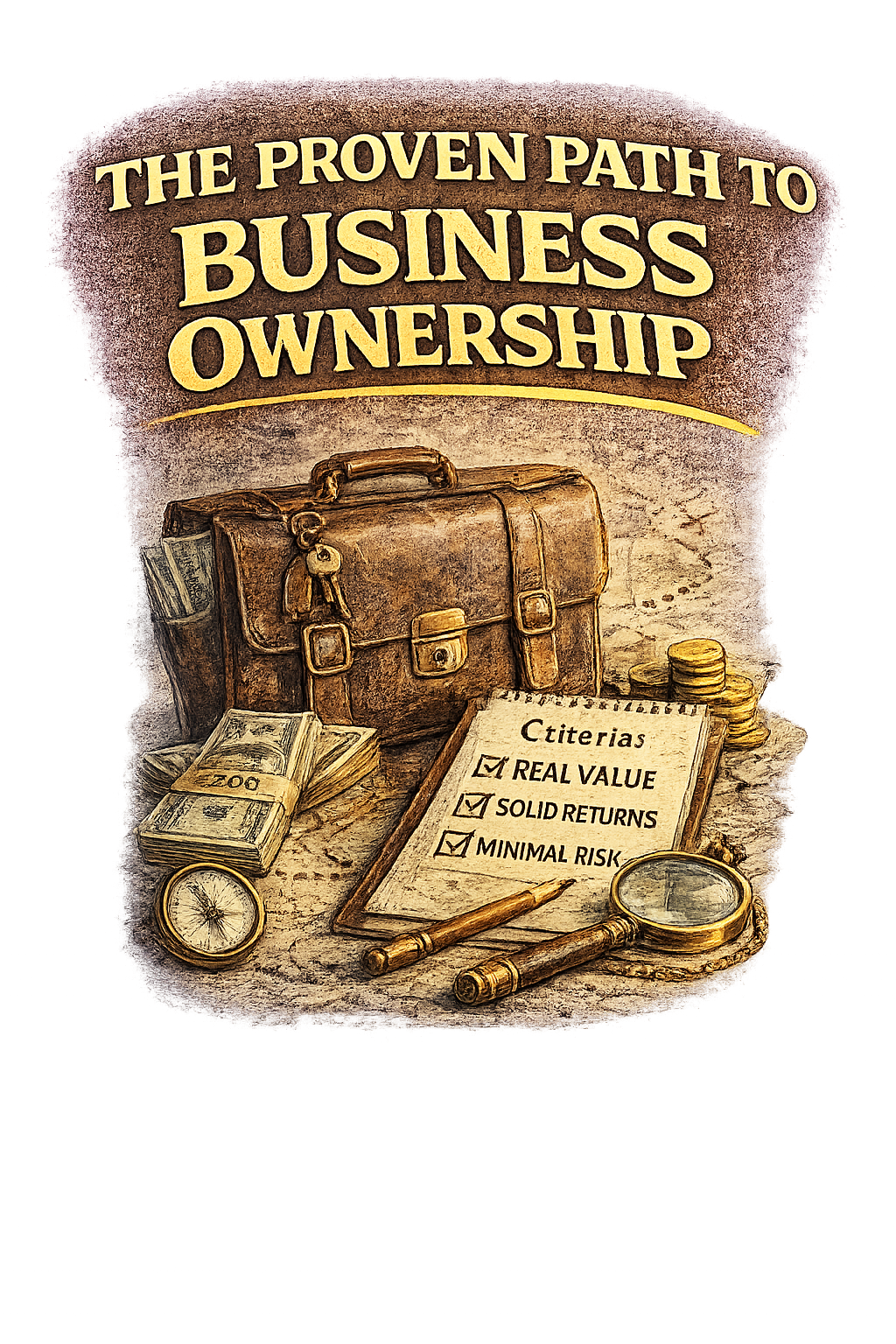
The Proven Path to Business Ownership
Buying a business is one of the fastest, most proven ways to build real wealth and one of the easiest ways to lose money if you do it without a process. The difference between buyers who succeed and buyers who get burned is rarely intelligence. It’s discipline and a repeatable process.
This page lays out that process step by step. It’s the practical companion to our complete guide on how to buy a business, and it links out to deeper resources at each stage so you can go as far down as you need.
Let’s start with the mindset, because it changes everything that follows.
First, Understand What You're Really Doing
Most first-time buyers believe finding a business is the hard part. It isn’t. Finding opportunities matters, but it’s only the beginning. The real challenge is knowing what to do when opportunity arrives.
Think of it this way. If someone dumped twenty thousand dollars of lumber in your driveway, you wouldn’t own a house. You’d own raw material. It only becomes a house once someone measures it, cuts it, frames it, and builds it. Deal flow is identical. A spreadsheet isn’t wealth. A lead isn’t a business. A seller saying “I might be interested” isn’t an acquisition. Even signing a non-disclosure agreement isn’t a deal. It’s all raw material until you do the work of turning it into ownership.
Here’s the difference that work creates. An inexperienced buyer receives a business and asks one question: “Is this a good deal?” A professional buyer asks a dozen better ones. What’s the cash flow? Why is the owner selling? Is the asking price realistic? Would a bank finance this? Does it depend too heavily on the owner? Are the financial statements clean? Is there a transition plan? Can I improve it? Does it fit my strategy?
Professionals don’t ask better questions because they’re smarter. They ask better questions because they’ve been trained to. That training is what this process gives you. Your job is to turn raw material into ownership — and that takes a repeatable process. Here it is.
Step 1: Define Your Acquisition Criteria
Before you look at a single business, get specific about what you’re looking for. A vague buyer attracts vague opportunities. A focused buyer recognizes the right opportunity immediately.

Write down, in real detail:
- The industries that fit your skills and interest
- Your preferred geography how far you’re willing to drive
- Your target cash flow range (in SDE more on that below)
- The kind of seller you want to work with
- The amount of capital you’re prepared to invest
A useful example of a criteria statement: “I’m looking for a stable service business within two hours of my home, producing between $250,000 and $750,000 in Seller’s Discretionary Earnings, with recurring revenue, repeat customers, and an owner preparing for retirement.”
The clearer you get, the easier every future conversation becomes. We expand on this in how to prepare to buy your first business.
Hold Yourself to Four Standards
As you move through the entire process, hold yourself to four standards that separate professional buyers from everyone else.
Be responsive. Momentum matters. If a broker emails, respond. If a seller calls, call back. If a lender requests information, get it to them quickly. Opportunity doesn’t wait, and silence communicates uncertainty. Professionals move.
Be prepared. Know your criteria, your budget, and your financing options. Know which industries fit your skills. A vague buyer attracts vague opportunities; a focused buyer recognizes the right one immediately.
Be professional. Sellers aren’t inventory they’re people who often spent decades building their business. Brokers aren’t obstacles they’re professionals matching the right buyer with the right seller. Banks aren’t ATMs they’re partners who finance quality businesses for qualified buyers. Treat everyone professionally, because your reputation begins long before you own your first business.
Be coachable. You’re not expected to know everything today. Every seller conversation, broker relationship, and lender request teaches you something. The buyers who stay coachable become the buyers who become owners.
Step 2: Build Your Deal Flow
Deal flow is the stream of opportunities crossing your desk. You build it through brokers, direct seller outreach, your network, and offmarket channels.
The most reliable source for most first time buyers is business brokers, because they represent sellers who are genuinely ready to transact. Brokers want four things from a buyer: responsiveness, preparation, professionalism, and realistic expectations. Give them those, and you’ll see better deals sooner. We cover the channels in detail in how to find businesses for sale and off market business acquisitions.
Don’t measure your progress by how many leads you receive. Measure it by how well you process them.

Step 3: Screen Every Deal Through Five Filters
Most businesses you review, you shouldn’t buy. That’s not failure it’s discipline. You become successful by consistently eliminating bad opportunities until you find the right one.

Run every deal through five filters:
- Fit: Does it match your criteria: industry, geography, capital, lifestyle, experience?
- Financial quality: Can you get tax returns, P&Ls, balance sheets, add backs, and payroll data to make a fact based decision?
- Seller motivation: Why are they really selling? Retirement and burnout are very different from “just testing the market.”
- Transferability: Will the business survive the owner leaving, or is the owner the business?
- Financeability: Will a bank lend on this? Clean cash flow that supports the debt is what makes a deal real.
A deal that clears all five is worth your time. A deal that fails one or two usually isn’t.
Step 4: Analyze the Cash Flow and Value the Business
Cash flow is king. Not revenue, not potential, not the story cash flow. It’s what pays your debt, your team, and yourself.
Most small businesses are valued on a multiple of Seller’s Discretionary Earnings (SDE). If a business produces $400,000 in SDE and similar businesses sell for three times cash flow, it might be worth about $1.2 million as a starting point, not a final answer. From there you adjust up for clean books, stable earnings, and diversification, and down for owner dependence, customer concentration, and messy financials.
Never overpay for potential. Pay for proven cash flow today; treat improvements as upside you earn later. The full method is on our how to value a business page, with deeper dives on SDE and EBITDA vs SDE.

Step 5: Approach the Seller the Right Way
When you find a real candidate, remember that sellers aren’t inventory they’re people, many of whom spent decades building the business. Win the person before you negotiate the numbers.

Respect the story first. Ask about how they built it, what they’re proud of, and what they want for their employees and customers after they leave. Credibility beats clever contracts. A simple, powerful way to open a conversation is to be genuinely curious and straightforward about your intentions, rather than leading with lowball tactics. We go deeper in questions to ask a business seller.
You’ll also encounter common objections and concerns, and handling them with steadiness builds trust. When a seller worries whether you can actually close, your preparation and financing readiness answer that. When they worry about their employees’ future, your respect for the team answers it. When they push back on price, your valuation logic grounded in real SDE and a fair multiple keeps the conversation rational rather than adversarial. Sellers rarely choose the highest offer alone; they choose the buyer they trust to close and to honor what they built. Being that buyer is a competitive advantage that costs you nothing.
Step 6: Get Pre Qualified for Financing
Leverage is your greatest tool as a buyer, and the most common path is an SBA loan. Banks care about a handful of things: dependable cash flow, a fair price, your character and experience, a reasonable down payment, and a business that can support the debt.
Prepare before you need financing. Get your personal financial documents in order, understand your borrowing capacity, and build a relationship with a lender early. A good bank also does serious independent due diligence on the business which protects you. Start with SBA loans for buying a business and how to finance a business purchase.

Step 7: Make a Written Offer

Once a deal clears your filters and you’ve built rapport, you make a formal written offer. Many buyers use a Letter of Intent (LOI); a well built Offer to Purchase can serve the same purpose while keeping every protection intact through contingencies.
Your offer should be contingent on satisfactory due diligence, financing, and clean documentation so you keep the ability to walk away if what you find doesn’t match what you were told. Learn the document in our Letter of Intent (LOI) guide.
Step 8: Conduct Due Diligence
Due diligence is where you verify what you already believe. You’re confirming that the financials are real, the customers are real, the contracts transfer, and there are no landmines.
Work through financial, legal, operational, customer, vendor, and HR due diligence systematically, and lean on your professional team your accountant, your attorney, and your lender. Don’t do this from memory. Use a structured due diligence checklist so nothing slips.

Step 9: Close the Deal

Closing is the coordination of the final pieces: the purchase agreement, the financing, the lease assignment, licensing, and the funds transfer. Your attorney and lender carry much of the load here.
Treat closing not as the finish line but as the starting line. The moment the deal funds, you’re an owner and the real work begins.
Step 10: Win the First 90 Days
In your first 90 days, preserve before you improve. Protect the five things that make the business work: its customers, its employees, its vendors, its reputation, and its cash flow. Learn the rhythm of the business before you change anything. Resist the urge to remodel on day one.
The instinct of many new owners is to arrive with a list of improvements and start executing immediately. That instinct is dangerous. You bought a business that works; your first job is to keep it working. Introduce yourself to key customers and reassure them nothing they value is changing. Tell the employees you recognize their importance and intend to keep the team intact. Confirm vendor relationships and pay on time. Watch how the money actually moves through the business across a full cycle before you touch pricing, staffing, or process.
Once you understand the rhythm and the team trusts you .you’ve earned the right to improve. The marketing upgrade or operational fix you spotted during diligence will still be there in 90 days, and you’ll execute it from a position of knowledge instead of assumption.
Reputation compounds. The trust you build with the team, the customers, and the community in those first months becomes the foundation everything else is built on.

A Worked Example: One Deal, Start to Finish
Let’s put the ten steps together with a realistic example.
A buyer defines her criteria: a service business within 90 minutes of home, $300,000 to $600,000 in SDE, with recurring revenue and a retiring owner. She tells three brokers exactly that and gets her personal financials organized so she’s financing ready.
Six weeks in, a broker sends a commercial landscaping company: $480,000 SDE, an owner retiring after 22 years, a book of recurring maintenance contracts, and a crew of nine who’ve been there an average of six years. She runs the five filters. Fit: yes. Financial quality: tax returns and P&Ls are available and organized. Seller motivation: genuine retirement, not market testing. Transferability: a foreman already runs daily operations. Financeability: the cash flow comfortably supports the debt. It clears all five.
She values it. At $480,000 SDE and a fair multiple of roughly 3x for a business this clean, the asking price of $1.45 million is reasonable. She meets the seller, leads with respect for what he built, and learns he mostly cares that his crew is kept on. That matters more to him than squeezing the last dollar.
She makes a written offer contingent on due diligence, financing, and clean documentation. Her lender begins underwriting; the bank’s independent diligence confirms the cash flow. Her accountant reconciles the books; her attorney confirms the contracts and lease transfer. Everything checks out. The deal closes in about four months from first contact.
On day one, she changes nothing. She keeps the foreman, reassures the crew, calls the top customers, and learns the rhythm before improving anything. That’s how raw material becomes ownership.
Make Sure You're Capital and FinancingReady
One reason that example moves smoothly is that the buyer prepared her financing before she needed it. Getting capitalready in parallel with your search is what lets you act decisively when the right business appears.
Before you’re deep into a deal, know your borrowing capacity, get your personal financial statement and tax returns organized, and build a relationship with at least one SBA experienced lender. Understand roughly how much you’ll need for a down payment and working capital so your criteria are grounded in what you can actually finance. A prepared buyer doesn’t lose a great business to a faster one. We cover the specifics in how to finance a business purchase and SBA loans for buying a business.
The Bottom Line
Buying a business isn’t about saying yes. It’s about knowing when to say no and being fully prepared to say yes when the right one appears. Define your criteria, build deal flow, screen ruthlessly, value on real cash flow, treat people well, finance smart, verify everything, and protect what you bought.
Do that, and one great acquisition can change your financial future. For the complete framework that ties all of this together, start with our pillar guide on how to buy a business
Frequently Asked Questions
It depends on the price and your financing. With an SBA loan, buyers often put down a portion of the purchase price (commonly around 10%), with the bank financing the rest against the business’s cash flow. The exact down payment varies by deal, lender, and your financial profile. The more important number is whether the business’s cash flow can comfortably support the debt.
From serious search to closing, the process commonly runs several months often three to nine depending on how quickly you find the right business, complete due diligence, and secure financing. Buyers with clear criteria and pre arranged financing tend to move faster because they recognize and act on the right opportunity sooner.
Yes, many first time buyers have no prior ownership experience. What matters is your willingness to learn, your relevant transferable skills, and buying a business that fits your background. Lenders and sellers both look for buyers who are coachable, prepared, and realistic rather than buyers who already know everything.
Buying an existing business means acquiring proven cash flow, established customers, trained employees, and working systems on day one which is why it’s often lower risk than a startup. A startup offers a clean slate but no track record. For most people seeking financial freedom, buying a profitable existing business is the faster, more reliable path.

Working With Us Is Easy
We've Made the Process Simple & Pain-Free
Call Now or Click Below
Call (800) 845-0188 or contact us here.
We'll Discuss Your Situation, Timeline & Goals
Phone, email, text or meeting in person, we'll do whatever it takes
You'll Engage Us for Services
We'll formalize an agreement and it will be full-service from here on out with a level of professionlism and communication that will blow you away!
Sold!
You now have peace of mind that your business was sold your way to the right buyer.