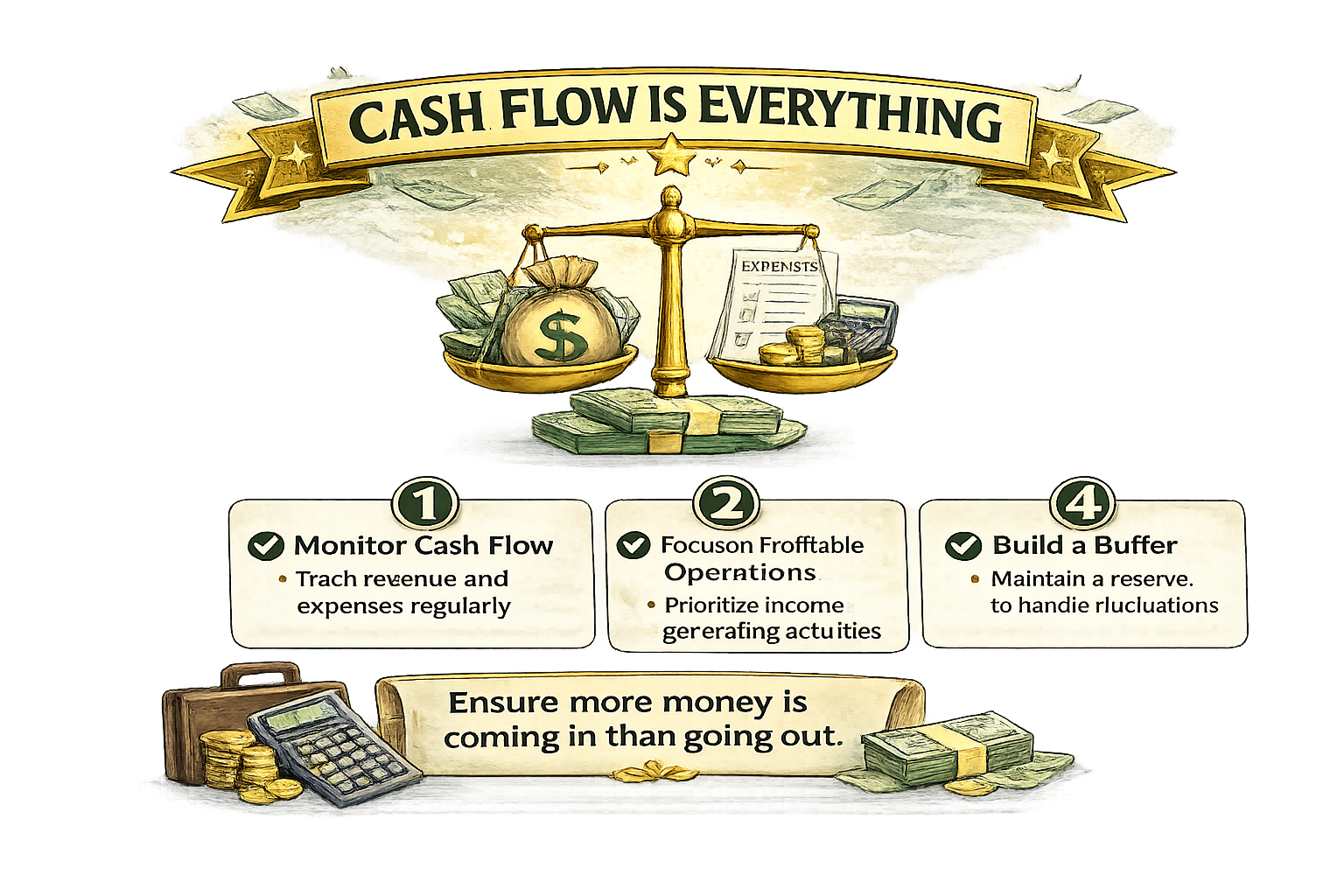
“The three most important things about buying, owning, or selling your business are: number one, cash flow. Number two, cash flow. And last but not least—cash flow.”
People laugh when I say it. Then they realize I’m not joking. I’m making the most important point I know how to make, and I’m repeating it three times so it actually sticks. Because in this business, almost everything that matters comes back to one thing: the money the business actually puts in your pocket.
I could give you a list of twenty things to evaluate in a business. Location. Brand. Equipment. Staff. Reputation. Market share. All of it matters. But if I let you walk away with twenty priorities, you’ll get lost in the noise and miss the signal.
So I collapse the whole list into one word and say it three times, because cash flow isn’t just the most important thing—it’s the first, second, AND third most important thing. Everything else is a distant fourth.
Revenue is vanity. Profit is sanity. Cash flow is reality.
When you buy a business, you are not buying its revenue. You’re not buying its brand or its history or the owner’s dreams. You’re buying its cash flow—the money left over after every real expense is paid.
This is where amateurs get destroyed. They fall in love with a big top-line number. “It does two million in sales!” Great. What does it keep? Because a business doing two million in sales and keeping fifty thousand is a job with extra steps. A business doing eight hundred thousand and keeping three hundred thousand is a machine.
The Number That Matters
In the acquisition world we obsess over a figure called SDE—Seller’s Discretionary Earnings—and its bigger cousin, EBITDA. Strip away the jargon and both answer one question: how much real cash does this business generate for its owner? That number sets the price. That number determines whether the bank lends. That number is what you’re buying. Everything in due diligence exists to verify that number is real.
Once you own the business, cash flow stops being a number on a spreadsheet and becomes the oxygen your company breathes. Plenty of profitable businesses go under—not because they weren’t profitable on paper, but because they ran out of cash at the wrong moment.
Profit is an opinion. Cash is a fact. You can show a profit and still miss payroll if your money is trapped in inventory or unpaid invoices. As an owner, your job is to manage the timing of money—when it comes in, when it goes out, and how much cushion sits between the two.
More businesses die from cash starvation than from lack of profit. Watch the flow, not just the bottom line.
The owners who sleep well are the ones who know their cash position cold. They know their margins. They collect fast and pay smart. They keep reserves. They treat cash flow like the heartbeat of the business—because that’s exactly what it is.
And when it’s time to sell? Cash flow is the whole ballgame. Your business will be valued as a multiple of its cash flow. That’s it. That’s the formula. Strong, clean, growing cash flow earns a higher multiple. Weak, messy, or shrinking cash flow earns a lower one—or no sale at all.
This is why I tell owners years before they sell to start running the business with the exit in mind. Every dollar of provable, sustainable cash flow you can show a buyer is worth several dollars at the closing table, because they’re paying a multiple of it.
Make Your Cash Flow Provable
Here’s the part owners miss. It’s not enough for the cash flow to exist—it has to be provable. Buyers and their banks don’t pay for cash you ran through the business off the books. They pay for cash flow documented in clean financials, tax returns, and bank statements. The cleaner and clearer your numbers, the higher and faster your sale.
Buying, owning, selling three completely different moments in the life of a business. And one thing ties all three together. Cash flow. It’s what you’re buying, what keeps you alive, and what you’re selling.
Master that single idea and you’ll make better decisions than people with twice your experience. Ignore it, and no amount of passion, branding, or hustle will save you.
Learn to read cash flow and you can read any business in the world.
The three most important things about buying, owning, or selling your business are cash flow, cash flow, and cash flow. I say it three times because it’s true three times over—at every stage, in every deal, for every owner.
At Peterson Acquisitions, we teach buyers to evaluate it, owners to protect it, and sellers to maximize it. Whatever stage you’re in, the conversation starts with the same question: what’s the cash flow? Let’s talk about yours.
Mostly no. An LOI is largely a non-binding framework that outlines proposed terms before the definitive purchase agreement. Typically only a few provisions are binding — most commonly confidentiality and, when included, an exclusivity period. The binding commitment to buy comes later, in the purchase agreement, and remains subject to your contingencies.
An LOI is largely non-binding and sets the stage for negotiation, while an Offer to Purchase is a more complete, actionable document that moves the deal forward more decisively. A well-built Offer to Purchase keeps every buyer protection intact through the same contingencies, so being more decisive doesn’t mean being less protected.
At minimum: satisfactory due diligence, financing approval, clean and transferable documentation, lease assignment if location matters, and an acceptable final purchase agreement. These contingencies are your most important protection — they let you renegotiate or walk away without penalty if what you verify doesn’t match what you were told.
Most small-business acquisitions are structured as asset sales, where you buy specific assets and generally avoid inheriting the seller’s past liabilities. Stock sales transfer the entire entity, including liabilities, and are often preferred by sellers for tax reasons. The right structure depends on tax and liability factors, so your attorney and accountant should advise on it.
Making an offer is where preparation meets opportunity. Work with Peterson Acquisitions to structure an offer that moves the deal forward while protecting everything that matters — and review the complete process in how to buy a business.
Call (800) 845-0188 or contact us here.
Phone, email, text or meeting in person, we'll do whatever it takes
We'll formalize an agreement and it will be full-service from here on out with a level of professionlism and communication that will blow you away!
You now have peace of mind that your business was sold your way to the right buyer.
Provide your name, email, and phone to start the process.
Please complete information on the next page as well. The information is necessary for your consultation.